Cat6 vs. Cat6A: Which Does Your Business Need?
Choose the Right Cabling for Long-Term Performance

Executive Summary: Cat6 and Cat6A both offer strong performance for commercial networks, but the right choice depends on your facility, bandwidth needs, cable distances, equipment, and future growth. Cat6 is often sufficient for standard offices, warehouses, and commercial environments, while Cat6A can provide additional capacity for 10 Gigabit Ethernet, high-bandwidth applications, and long-term infrastructure planning.
Cat6A Might Be Newer, But It’s Not Always Necessary
When a business is planning a new network cabling installation, one of the most common questions is whether to install Cat6 or Cat6A cable. At first glance, the choice may seem simple. Cat6A is the newer, higher-performance option, so why not use it everywhere?
In reality, faster isn't always better if your network doesn't need the additional capability. Cat6 remains a strong choice for many offices, warehouses, commercial buildings, and other business environments. Cat6A, meanwhile, can make sense when higher speeds, longer cable runs, increased bandwidth, or future network demands justify the additional investment.
At Cal Comm Systems, we believe the right cabling system should be based on how your business actually operates, not simply which cable has the highest specifications.
Here's what businesses should know when comparing Cat6 vs. Cat6A.
What Is Cat6 Cable?
Category 6, better known as Cat6, is a twisted-pair Ethernet cable commonly used in commercial network installations. Cat6 supports data rates up to 1 Gbps at distances of up to 100 meters, or about 328 feet. It can also support 10 Gigabit Ethernet, but only over shorter distances.
For many businesses, that's more than enough performance. A typical office may need cabling for:
- Desktop computers and workstations
- VoIP phones
- Printers
- Wireless access points
- Security cameras
- Conference rooms
- Point-of-sale systems
- Other connected equipment
Cat6 can handle many of these applications very well when the network is properly designed and installed. That's important because cable selection is only one part of network performance. Proper termination, cable routing, patch panels, switches, access points, and installation practices all matter too.
What Is Cat6A Cable?
Cat6A stands for Category 6 Augmented. One of its biggest advantages is its ability to support 10 Gigabit Ethernet at distances of up to 100 meters. Cat6A is also designed to provide better protection against crosstalk and interference.
That makes it particularly useful for businesses with demanding network environments or those that want to prepare their infrastructure for greater bandwidth requirements.
Cat6A cable is generally thicker than Cat6 and requires more consideration during installation. Cable pathways, conduit capacity, bend radius, patch panels, termination hardware, and cable management all need to be planned accordingly. In other words, choosing Cat6A isn't simply a matter of swapping one cable for another. The entire structured cabling system needs to support it.
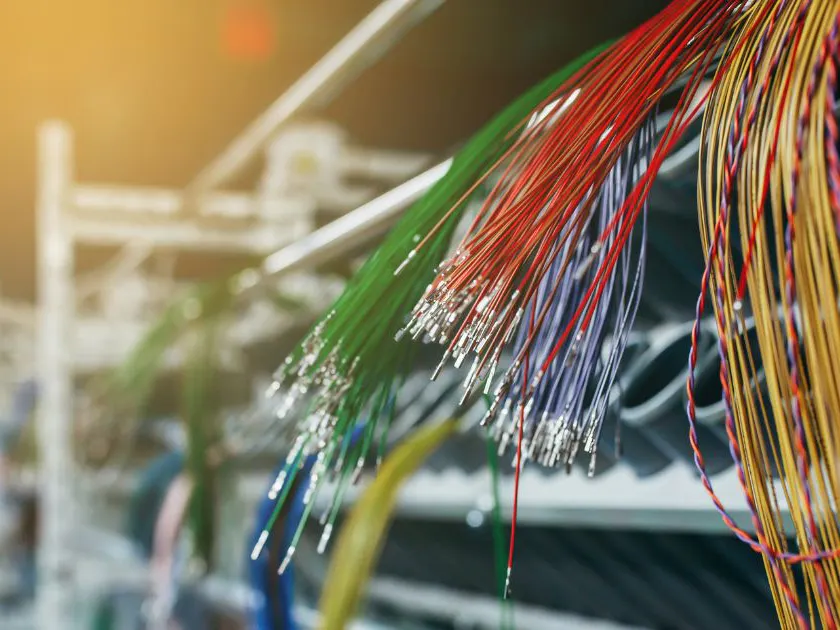
Selecting the right cable for your office or warehouse helps you future proof your space for growth and development.
Cat6 vs. Cat6A: What's the Biggest Difference?
The biggest practical difference is 10 Gigabit Ethernet performance over longer distances. Cat6 can support 10 Gbps over shorter cable runs, while Cat6A is designed to support 10 Gbps across the full 100-meter Ethernet channel.
That distinction matters more in some businesses than others.
If you're wiring a relatively small office where most employees use standard cloud applications, email, web browsers, VoIP phones, and wireless devices, Cat6 may provide all the performance you realistically need. If you're building an environment where large amounts of data regularly move across the local network, Cat6A may be worth considering.
Examples could include facilities with high-performance workstations, large numbers of wireless access points, network storage, engineering applications, media production, data-heavy operations, or other bandwidth-intensive systems.
When Does Cat6 Make Sense?
We still see plenty of situations where Cat6 is a practical business choice. For a standard commercial network, Cat6 can provide excellent performance without adding unnecessary installation costs or complexity.
It may be a good fit for businesses such as:
- Small and midsize offices
- Retail locations
- Warehouses
- Medical and professional offices
- Schools
- Light industrial facilities
- Restaurants
- Commercial buildings with typical network demands
Cost can also play a role. Cat6 cable and compatible components are generally less expensive than Cat6A, and the smaller cable diameter can make it easier to install in crowded pathways.
That doesn't mean businesses should automatically choose Cat6 to save money. Instead, we look at the network requirements, cable distances, building layout, equipment, and expected future needs before recommending a solution.
When Should You Consider Cat6A?
Cat6A becomes much more attractive when a business expects to use 10 Gigabit Ethernet throughout the building. It can also make sense when the cabling is being installed in a facility where replacing it later would be difficult or expensive. Consider a large warehouse, for example.
Running new cable through an active warehouse may require scissor lifts, working around inventory, coordinating installation around employees, and accessing cable pathways high above the floor. If a business expects its network demands to increase substantially over the next several years, investing in higher-capacity cabling during the initial installation may be easier than replacing infrastructure later.
Cat6A can also be worth considering for:
- New commercial construction
- Major office renovations
- High-bandwidth networks
- 10 Gigabit Ethernet deployments
- Data-heavy businesses
- High-density wireless networks
- Facilities where network infrastructure needs to remain in place for many years
The goal isn't to install Cat6A simply because it's available. The goal is to determine whether its additional capabilities provide meaningful value to the business.
Don't Forget About Wireless Access Points
Businesses sometimes think faster Wi-Fi means Ethernet cabling is becoming less important. In many cases, the opposite is true.
Your wireless access points still need wired network connections. As wireless technology becomes faster and businesses connect more devices, the infrastructure behind those access points becomes increasingly important.
A business may have dozens or hundreds of laptops, phones, tablets, scanners, cameras, and other devices connecting wirelessly. That traffic eventually has to travel through the wired network. For businesses upgrading wireless infrastructure, it is worth evaluating whether the existing cabling will support both current access points and future upgrades.
Depending on the equipment and network design, that may influence whether Cat6 or Cat6A is the better choice.
Think About Power Over Ethernet, Too
Network cabling isn't only carrying data anymore. Power over Ethernet, or PoE, allows compatible network cables to provide both data and electrical power to devices such as wireless access points, VoIP phones, security cameras, access-control equipment, and other connected systems.
As businesses install more PoE-powered equipment, cable selection, bundle sizes, heat, pathway design, and installation quality become increasingly important. This is another reason we recommend looking at structured cabling as a complete system rather than choosing cable based on a single specification.
Should You Install Cat6A to Future-Proof Your Business?
"Future-proofing" gets used a lot when discussing network cabling. There is some truth behind it. Cabling is often expected to stay inside walls, ceilings, conduit, and warehouse spaces much longer than switches, computers, or wireless access points remain in service.
Installing infrastructure with additional capacity can reduce the need for replacement later. But future-proofing doesn't necessarily mean buying the highest-category cable available.
Businesses should consider questions such as:
- How long do we expect to use this building? A company planning to remain in a facility for 15 years may approach infrastructure differently than a tenant with three years left on a lease.
- What network speeds do we actually need? There's little benefit in paying for capabilities that your equipment and applications are unlikely to use.
- How difficult will the cable be to replace? Cable installed in easily accessible office ceilings is different from cable routed through conduit or installed 30 feet above a warehouse floor.
- Are our bandwidth requirements increasing? Businesses moving large files, expanding cloud operations, adding cameras, deploying faster wireless networks, or increasing connected equipment may have different requirements than a small professional office.
Cat6A Isn't Automatically a Better Installation
One of the biggest mistakes businesses can make is focusing entirely on the category printed on the cable jacket. A poorly installed Cat6A network isn't automatically better than a properly designed Cat6 network.
Structured cabling requires attention to cable pathways, separation from electrical equipment, termination quality, bend radius, labeling, testing, patch panels, racks, cable management, and future accessibility. We've been installing and maintaining commercial network infrastructure for more than 20 years, and one thing remains consistent: good planning matters.
The goal should be a clean, organized system that performs properly today and is manageable when your business needs to make changes later.
Cat6 or Cat6A? Start With Your Business Requirements
There isn't one answer that works for every business. For many commercial installations, Cat6 continues to provide a reliable combination of speed, capability, cost, and installation flexibility. For businesses that require 10 Gbps across longer distances, expect heavier network demands, or want additional infrastructure capacity for the future, Cat6A may be the better investment.
At Cal Comm Systems, we evaluate more than the cable itself. We look at your building, network equipment, cable distances, pathways, connected devices, growth plans, and how your team actually uses the network.
Whether you're wiring a new office, expanding a warehouse, upgrading outdated cabling, or planning a larger network infrastructure project in Southern California, we'll help you determine what makes sense for your facility. The best network isn't necessarily the one with the most expensive cable. It's the one designed and installed around what your business actually needs.


